
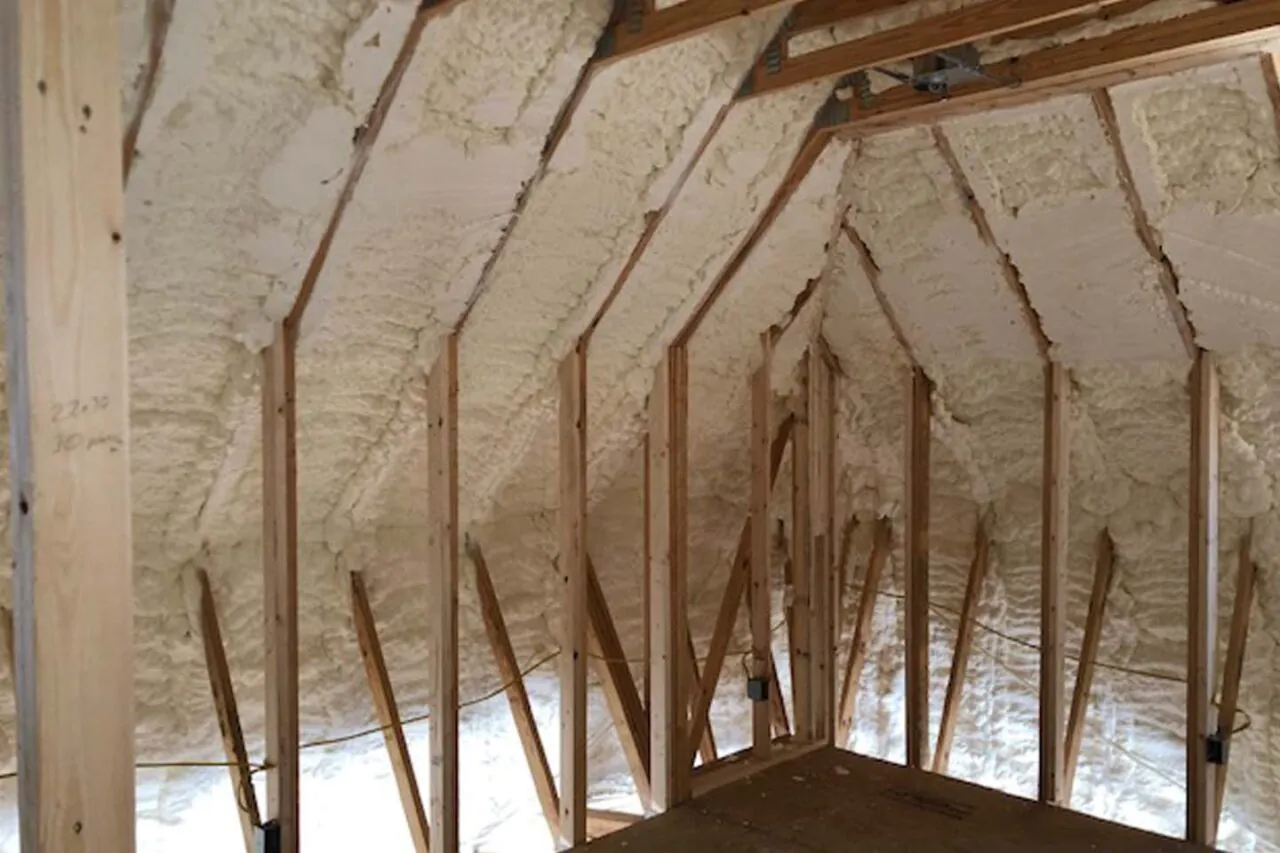
For years, many Tallahassee homeowners assumed attic insulation meant one thing: a thick blanket of fiberglass across the attic floor. Here in North Florida, that usually means an insulation level of R-38 to meet the state energy code for climate zone 2. But the new R-20 spray foam Florida code path changes the math.
Section 553.9065 of the Florida Statutes, effective July 1, 2025, says an unvented attic insulated with at least R-20 air-impermeable spray foam insulation at the roofline can now meet the Florida Building Code, 8th Edition (2023), Energy Conservation when certain conditions are met. In plain English, Florida Building Code 553.9065 now recognizes a tighter roofline assembly with a lower R-value as a code-compliant option.
That matters because the new Florida unvented attic R-20 path is not just about using less insulation. It also moves the attic and ducts into a more controlled space. If you are planning a new build or attic upgrade, start with a free estimate for spray foam insulation in Tallahassee.
The Math That Changed: R-38 Fiberglass vs. R-20 Spray Foam
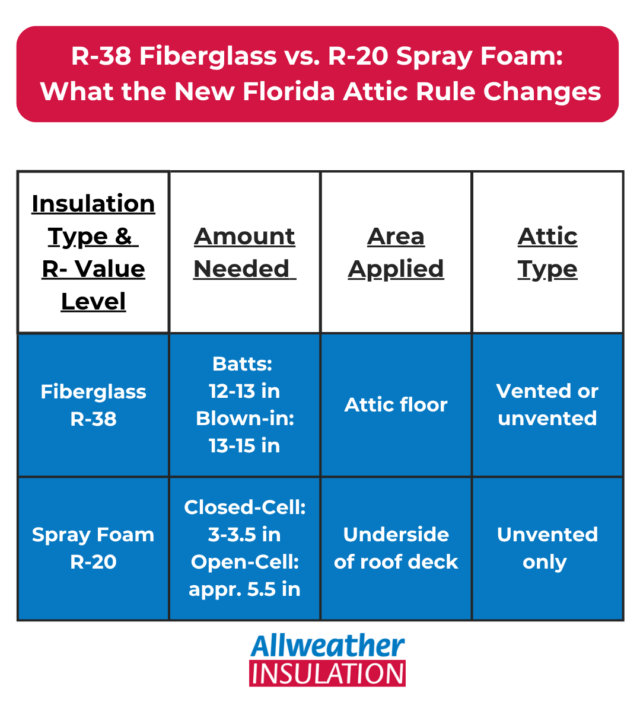
The chart below shows how fiberglass and spray foam look side-by-side when considering the new R-20 rule.
The amount of insulation needed is a major factor in the R-38 fiberglass vs R-20 spray foam choice. One approach puts more insulation on the attic floor while the other uses a shorter, denser assembly under the roof deck. That can mean less product, less labor time, and a tighter envelope.
The efficiency story matters too. The U.S. Department of Energy notes that HVAC systems in unconditioned vented attics typically increase heating and cooling energy use by about 10%, and duct leakage can commonly exceed 20% of conditioned airflow. Moving the thermal boundary to the roofline and creating an unvented attic eliminates that excess.
The bottom line is two-fold: a smaller insulation install and better system efficiency can mean less money invested in the attic and lower energy bills over time.
What Section 553.9065 Requires
The Four Conditions You Have to Hit
The new law is not a shortcut around good construction. It is a clear performance-based path for a sealed attic assembly Tallahassee homeowners can take advantage of when the whole home is built to perform. The following four conditions are not a wish list. They are required, together, for the R-20 assembly to be recognized as code-compliant.
Condition 1:
First, a home must pass the blower door test 3 ACH50 Florida requirement. This allows a home to only have three or fewer air changes per hour at 50 Pascals. This shows that a home leaks very little air, is considered “tight” and energy efficient.
Condition 2:
Second, a home must have whole-house mechanical ventilation. It could be a positive input ventilation system, a balanced system, or a hybrid. A tight home needs controlled fresh air.
Condition 3:
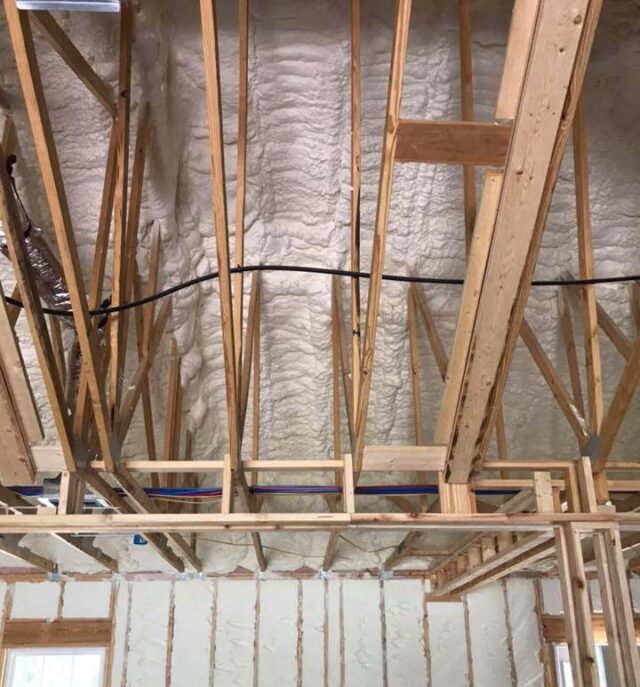
Next, thermal bridging at exposed rafters must be addressed. If the exposed rafters are not already covered by the R-20 foam or a finished ceiling, those areas need at least R-3 air-impermeable insulation. This can be waived when continuous insulation is installed above the roof deck instead.
Condition 4:
Lastly, all HVAC equipment and ductwork must be inside the building’s thermal envelope. This condition makes the whole assembly work because now the HVAC is in a conditioned attic that stays cool year-round.
When all four conditions are met, the entire system performs better than R-38 in an unconditioned attic. That’s exactly why the Florida legislature recognized this as a viable option.
When the R-20 Roofline Path Makes Sense (and When It Does Not)
Is the R-20 Roofline Path Right for Your Home?
The strongest candidates for the R-20 unvented path include:
- New construction homes with HVAC systems designed to run in the attic.
- Existing homes with HVAC equipment and ducts in an unconditioned attic. These homes will see the greatest efficiency upgrade.
- Homes scheduled for a roof replacement where it makes sense to add spray foam at the same time.
- Homes with low attic pitch, where 12 or more inches of fiberglass would be hard to install properly.
 But the R-20 path is not always the best answer. The traditional option of installed fiberglass on the floor can still be the right choice, especially for:
- Existing homes with ductwork already inside conditioned space, such as in interior soffits or between floors, since the HVAC efficiency argument would not apply.
- Homeowners with tight renovation budgets where the cost of spray foam installation would outweigh the material savings.
- Homes where the envelope cannot meet the air-tightness requirement without significant remediation.
Ultimately, the choice between spray foam vs fiberglass for your attic in Florida comes down to your home and budget. The best place to start is with a thorough attic inspection and a conversation about the project’s goals.
FAQs
Quick Answers to Common Questions
Q: How much spray foam do I need for an R-20 attic in Florida?
Closed-cell spray foam typically reaches R-20 at about 3 to 3.5 inches under the roof deck. Open-cell foam usually needs around 5.5 inches. A qualified installer will ensure the right product and thickness are applied based on your roof assembly.
Q: Does the R-20 rule apply in Tallahassee and Leon County?
Yes. Section 553.9065 applies statewide in Florida. Leon County is in Climate Zone 2, where the traditional attic floor path is usually R-38.
Q: Can I use open-cell spray foam or do I need closed-cell?
Both may qualify because the statute calls for “air-impermeable insulation.” Choosing between open-cell vs closed-cell attic insulation for your Florida home depends on the roof assembly, moisture considerations, budget, and goals.
Q: Do I need to stop using fiberglass?
No. Fiberglass is still a code-compliant, cost-effective option for standard vented attics with floor insulation. The R-20 spray foam path is an alternative, not a replacement.
Q: Does this apply in South Georgia?
No. Florida Section 553.9065 only applies to Florida homes. Georgia has its own energy code rules under the Georgia State Minimum Standard Energy Code, so South Georgia homeowners should check local requirements.
Maximize Energy-Efficiency for Less
Ultimately, this recent Florida code provision can be summed up as less product, same code, and better efficiency. Allweather Insulation is here to help you compare options, understand available energy efficiency programs, and choose the right assembly for your Tallahassee home. Our expert team is here to answer your insulation questions. Contact us today at 850-942-5557 or request a free estimate now.
References
ENERGY STAR. “Seal and Insulate with ENERGY STAR.” U.S. Environmental Protection Agency, www.energystar.gov/saveathome/seal_insulate.
Florida Legislature. “Chapter 553 Section 9065 — Thermal Efficiency Standards for Unvented Attic and Unvented Enclosed Rafter Assemblies.” The Florida Senate, 2025 Florida Statutes, https://www.flsenate.gov/Laws/Statutes/2025/553.9065. Enacted as s. 7, ch. 2024-191 (HB 267), signed 17 May 2024: effective 1 July 2025.
Pacific Northwest National Laboratory. “Unvented Conditioned Attic with Spray Foam Insulation Below Roof Deck.” Building America Solution Center, U.S. Department of Energy, https://basc.pnnl.gov/resource-guides/unvented-conditioned-attic-spray-foam-insulation-below-roof-deck.
Pacific Northwest National Laboratory. “Whole-House Ventilation Strategies for New Homes.” Building America Solution Center, U.S. Department of Energy, basc.pnnl.gov/resource-guides/whole-house-ventilation-strategies-new-homes.
University of Florida, Institute of Food and Agricultural Sciences. “Insulation.” Living Green, livinggreen.ifas.ufl.edu/topics/energy/insulation/.